When you design a new machine, you’re faced with many decisions at once. The safety switch is an essential component that can easily be overlooked, but from a technical standpoint, it’s crucial to a machine’s safety and reliability.
You usually don’t realize you’ve made the wrong choice until later: a switch that can’t withstand the environment, needs to be replaced too often, or is difficult to replace because the wrong connector type was chosen.
On our blog Choosing a Safety Switch? Follow These 10 Steps for Success We cover the entire process. In this article, we’ll take a closer look at the selection criteria for the component itself, so that you, as a machine builder, have a clear overview of all the key considerations before making a decision.
In a nutshell
- The type and lock setting determine all subsequent options.
- Certification and performance level are determined based on the risk analysis.
- Environmental requirements determine the appropriate material, seal, and temperature range.
- Connections and terminal configurations are key factors in installation and maintenance.
- The supply chain is just as important as the technical specifications.
1. Start with the type and the lock
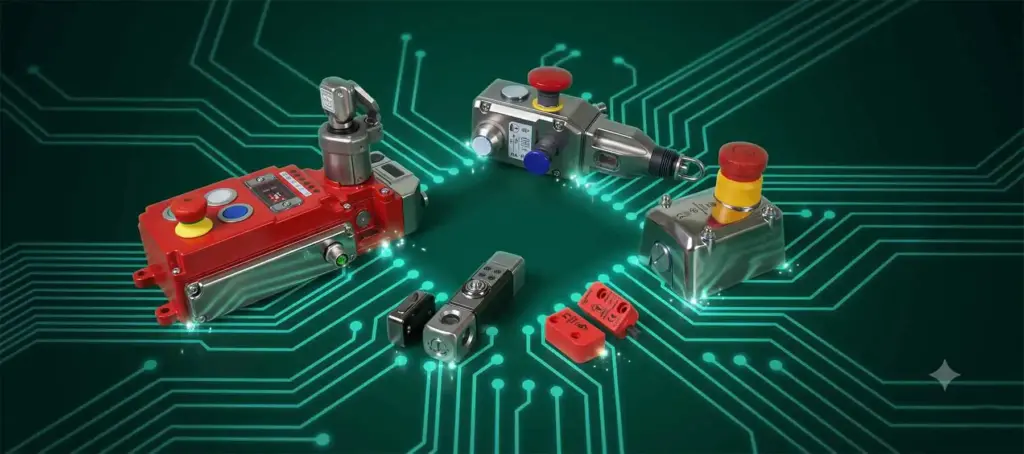
Safety switches come in various types: tongue switches, non-contact switches, interlocked switches, and key-lock systems. The type that is best suited for a given application depends on the type of safety measure, the design of the access point, and the environment.
In addition, determine early in the design process whether the switch must be guard-locked. Guard locking is required if the machine has a run-down time or if entering the hazard zone during operation poses a risk. It is a design decision that directly determines the choice of switch and the control logic.
2. Certification and Performance Level
The required Performance Level (PL) is determined by the machine’s risk analysis. Only then should you select a switch that demonstrably meets this level.
In addition to the PL, also verify that the switch has the appropriate certifications. CE marking is required for the European market. For applications in explosive environments, also inquire about ATEX certification.
3. Environmental Requirements: Materials, Sealing, and Temperature
The environment largely determines which version you need. In our view, these three questions are key:
| What material is recommended for the housing? | What type of seal is required? | Within what temperature range must the switch operate? |
|---|---|---|
| For standard applications, plastic is sufficient. In the food industry or pharmaceutical manufacturing, 316 stainless steel is a better choice due to its chemical resistance and ease of cleaning. | IP65 means dust- and splash-proof. IP67 can prevent problems during submersion. IP69k is preferred when cleaning with high pressure or steam.m | Verify that the switch is rated for the ambient temperature in your application, such as -25 °C in refrigerated or frozen environments. |
4. Connections and Contacts
A practical but often overlooked question is how the switch is connected. Is a standard wire connection sufficient, or is a connector preferable for easy installation and maintenance? Connector connections allow for quick installation and removal, which is a major advantage for machines that are regularly cleaned or disassembled.
Also specify the desired contact configuration, depending on the control configuration. And specify the desired type of output signal: standard contacts, OSSD (Output Signal Switching Device), or, for example, IO-Link.
5. Procurement and Supply Chain
Technical specifications are only half the battle. Questions that are just as important:
- Is the per-unit price acceptable to you? Some machine manufacturers offer plastic safety switches as standard, and for an additional charge, the customer can opt for stainless steel.
- What is the standard lead time from the factory, and can arrangements be made to ensure a stable supply chain (such as call-off orders)?
- Is there any information regarding long-term availability? Is there a known End of Life (EOL) date?
- Is the switch supplied by a reliable and approved supplier with verifiable certifications and manufacturer support?
Teleson supplies safety switches from IDEM Safety Switches and is happy to assist you in selecting the right model, connection, certification, and supply chain.
Getting Started with the Selection
All of the above criteria are compiled in the free safety switch checklist. Go through it before making a final decision or requesting a quote, so you can be sure the component meets the technical requirements of your machine design, the environment, and the supply chain. Download the checklist, or contact Teleson for advice on your specific application:
sales@teleson.nl | +31 30 263 1000

Frequently Asked Questions
What is the difference between a locked and an unlocked safety switch?
What is an OSSD output on a safety switch?
When do I need a switch with an IP69k rating?
IP69K means that the switch is resistant to high-pressure water jets at close range. This may be a requirement in the food industry and pharmaceutical manufacturing, where machines are regularly cleaned with steam or high-pressure water. Read more about this in our blog Choose IP69K safety switches to protect against moisture and malfunctions >>.